Your Health Knowledge Might Already Be Outdated
The “Historic Reset” of the U.S. Dietary Guidelines: How the Return to Real Food is Changing the World and Washoku
January 7, 2026 — The U.S. government has officially released the “Dietary Guidelines for Americans 2025–2030.”
This update is far more than a routine nutritional refresh. Led by figures such as HHS Secretary Robert F. Kennedy Jr. under the slogan “Make America Healthy Again (MAHA),” this revision is a “historic reset” that fundamentally overturns decades of nutritional policy.
The Message is Strikingly Simple: “Eat Real Food”
The core of these new guidelines can be distilled into three words: Eat Real Food.
The focus has shifted from consuming “products” to eating “food”—prioritizing ingredients in their natural state or those that are minimally processed. This simple principle forms the foundation of every new recommendation.
1. A Definitive “NO” to Ultra-Processed Foods (UPF)
The guidelines now use the strongest language to date to urge the avoidance of Ultra-Processed Foods.
-
Salty/sugary snacks, cookies, and candies.
-
Processed meats.
-
Sugar-sweetened beverages (sodas, energy drinks).
These are no longer categorized as items to enjoy “in moderation”; they are explicitly identified as primary drivers of poor health.
2. The “Promotion” of Protein
Recommended intake: 1.2 to 1.6g per kg of body weight.
One of the most impactful changes is the significant increase in protein requirements.
-
Old Standard: 0.8g per kg of body weight.
-
New Standard: 1.2 – 1.6g per kg of body weight.
Furthermore, there is a major re-evaluation of animal proteins. Eggs, poultry, seafood, and even red meat are now championed as “nutrient-dense foods.”
3. The End of the “Fat is Evil” Era
The long-standing war on fat has come to an end.
-
Full-Fat Dairy: Whole milk and full-fat cheese are now officially recognized as healthy options.
-
Shift in Cooking Oils: The bias toward seed oils has shifted back to traditional fats like butter, beef tallow, and olive oil.
Note: While the 10% limit on saturated fats remains (a point of contention for some critics), the cultural shift toward natural fats is undeniable.
4. Serious Regulation of Added Sugars
The stance on sugar is stricter than ever:
-
Under 10g of added sugar per meal.
-
Zero added sugar for children under 4 (especially those under 2).
-
Artificial sweeteners are no longer recognized as part of a healthy diet.
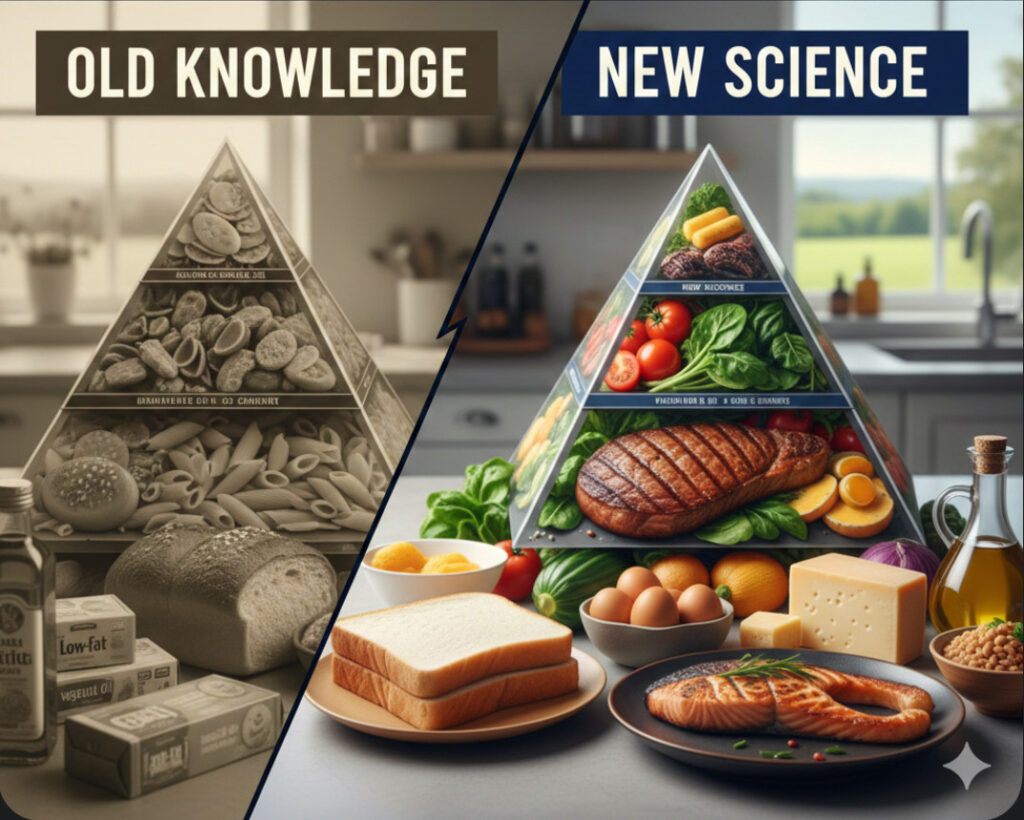
5. The Food Pyramid has been “Inverted”
The old pyramid had grains at the base. The new model essentially flips this:
-
Priority: Protein, dairy, healthy fats, vegetables, and fruit.
-
Lower Tier: Grains, especially refined carbohydrates (white bread, crackers, etc.).
Carbohydrates have moved from being the “star of the show” to a “luxury item.”
A Global Paradigm Shift
These guidelines will trigger a ripple effect far beyond the United States.
-
Dining Out: High-quality steaks and full-fat cheeses will appear on “healthy” menus; kitchens will swap seed oils for tallow and butter.
-
Manufacturing: “Clean labels” with minimal ingredients and “No Added Sugar” will become the global standard.
-
Agriculture: A shift from grain-heavy production toward livestock, vegetables, and small-scale farming that prioritizes “nutrient density” over “cheap calories.”
Why This Matters for Japan and Washoku
While Washoku (Japanese cuisine) has a global reputation for being healthy, Japan actually has a surprisingly high consumption of ultra-processed foods. This shift suggests three major changes:
-
Redefining Washoku: A shift from “Rice as the lead” to “Protein as the lead, with a small side of rice.”
-
Oil and Additives: A move away from “salad oils” toward rice bran oil or olive oil, and a stricter eye on convenience store ingredients.
-
The MAHA Phenomenon: A growing question among the younger generation: “If the world has changed, why hasn’t Japan?”
Tailwinds and Headwinds for Washoku
-
Tailwinds: Fermented foods (Miso, Shoyu, Natto), Dashi culture (aiding salt reduction), and seafood as an ideal protein source.
-
Headwinds: The declining status of white rice (refined carb) and the need to rethink the traditional “Ichiju-Sansai” balance.
Conclusion: Washoku is Evolving, Not Disappearing
These guidelines do not negate Washoku; rather, they offer the power to return modern Japanese cuisine—which arguably became distorted after WWII—to its original, “ingredient-focused” roots.
We are moving from a culture of “filling up on rice” to a culture of “savoring high-quality protein and fermented foods.” It seems modern science is finally catching up to the intuition that Japanese people have held for centuries.