Making Ehomaki with Australia’s Bounty
— Choosing to Connect Tradition, Not Just Preserve It —
In Japan, Setsubun is an important seasonal event, marked by prayers for good health and protection from illness.
People throw roasted soybeans, face the auspicious direction of the year, and eat Ehomaki in silence.
For many, this is a food custom they’ve known since childhood—an ordinary yet deeply ingrained part of Japanese culture.
But when we live outside Japan, how should we receive and practise this tradition?
Is simply recreating “the same as Japan” really the right answer?
When sharing Japanese food culture overseas, we often face these questions:
- The same ingredients aren’t available
- How far should we go in reproducing flavour and appearance?
- Is it still “authentic”?
Of course, accuracy and respect for tradition matter.
At the same time, I keep coming back to this thought:
Culture only stays alive when it takes root in the land where it is practised.
An Ehomaki made entirely with Australian ingredients
This Setsubun, we tried something new:
Reimagining Ehomaki using only Australian ingredients.
Seven ingredients, inspired by the Seven Lucky Gods:
- Lebanese cucumber
Close in texture to Japanese cucumber, offering freshness and balance - Roasted beetroot
Vivid colour and the power of polyphenols - Portobello mushroom
Sautéed with balsamic vinegar and black sugar—rich umami and β-glucan, rivaling shiitake - Pan-fried halloumi
Its springy texture as a new interpretation of tamagoyaki - Tasmanian salmon
Rich in EPA and DHA—one of Australia’s proud, health-supporting fish - Tiger prawn
Firm, juicy texture and auspicious red colouring - Pickled yellow capsicum
A crunchy stand-in for takuan, adding vitamin C and overall balance
A chef’s playfulness, guided by local wisdom
For a hidden accent,
we used Vegemite instead of wasabi.
In the sushi rice seasoning,
we added a touch of apple vinegar and a splash of whisky,
bringing depth that felt unmistakably Australian.
To avoid losing “Japaneseness,”
we deliberately chose not to make it the same as Japan.
That, too, is a form of sincerity as a cook.
South-southeast pointed to Australia
This year’s auspicious direction was south-southeast.
Looking at a world map,
from Japan, that direction leads to Australia.
Eating this Ehomaki,
on this land,
facing this direction—
I felt a quiet, inexplicable sense of connection.
Not “preserving” culture, but letting it circulate
What our NPO aims for is not simply exporting Japanese food as it is.
- Respect local ingredients
- Translate culture into forms people here can understand
- While never losing the core of Japanese values
To protect tradition does not mean refusing change—
it means not letting its meaning disappear.
This Australian Ehomaki is one small example of that practice.
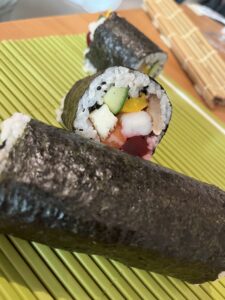
(And honestly, it tasted quietly very good.
Plating-wise… well, that’s room for growth next time.)
Food culture connects people and place
Making Japanese celebrations
with the ingredients of the land we live on—
We believe this does not dilute Japan,
but rather allows Japanese culture to live longer and deeper.
May this small dish become part of a future
where culture continues to circulate through food.