Behind the Kitchen | Touching the Reality of a Chef: Candid Dialogue Vol. 2
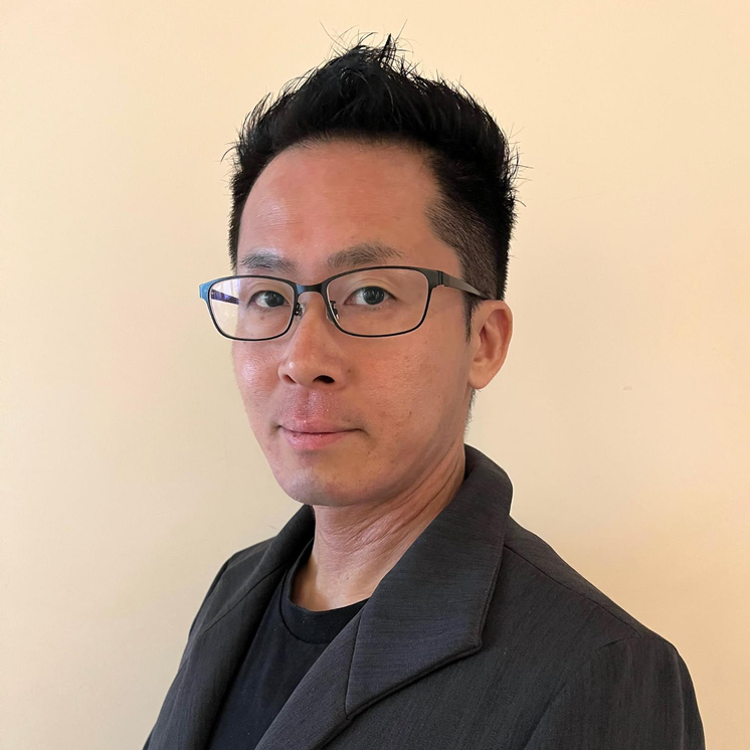
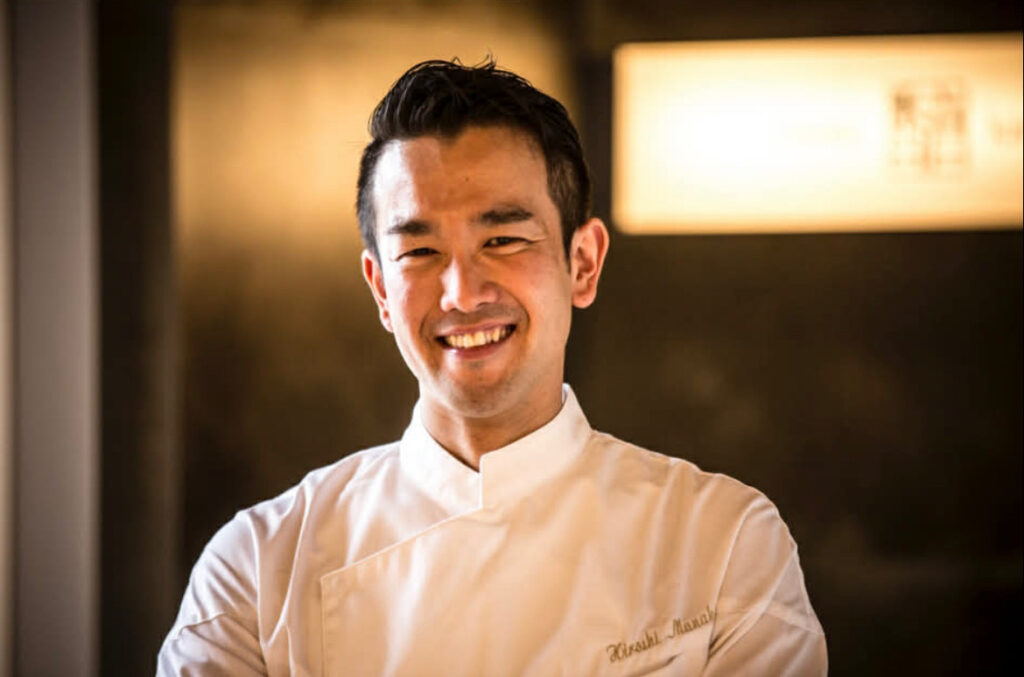
Chef Hiroshi Manaka
Our guest today is Chef Hiroshi Manaka, a culinary artist who has honed his craft in Michelin-starred restaurants across Italy, Spain, and France. He possesses a unique perspective that transcends national borders and culinary genres.
Some of you might wonder, “Wait, this is the Washoku Oceania Network—why are we featuring someone who doesn’t cook traditional Japanese food?”
However, once you experience his dishes or hear him speak, you realize instantly: a Japanese spirituality and sensibility breathe naturally through every element of his current work. His restaurant, “Five,” derives its name from the Japanese philosophy of Gogyo (The Five Elements) and the culinary principles of the Five Flavors, Five Colors, Five Methods, Five Suitabilities, and Five Senses. Hearing that, I knew I had to sit down with him.
In our interview, he shared his intense passion for cooking, but also revealed sides rarely seen: his struggles with isolation during his training years and the internal conflicts of working abroad.
What struck me most was that even now, having achieved his childhood dream, he says:
“Honestly, I’m still inside that dream.”
This dialogue reminded me of the profound depth and beauty of being a chef. We also had a great laugh over the fact that, originally, he didn’t even plan on becoming an Italian chef!
Let’s dive in.
The Interview Begins
(Interviewer)
Thanks for being here today. It feels a bit different from our usual chats, but let’s have some fun with it.
(Chef Manaka)
Now I’m getting nervous! (Laughs)
Q: What first led you to the world of cooking?
To be honest, there wasn’t one “eureka” moment. It’s more that I woke up one day and realized being a chef was my dream. Apparently, I wrote in my elementary school yearbook that I wanted to “be a chef and own my own restaurant.” I don’t remember it clearly, but I’ve felt that way since the second grade.
My mom loved cooking, and I helped her a lot. She was great at making meat sauce, which was a huge hit with my friends. Whenever they came over, I’d serve it to them. I think I naturally felt then that delicious food has the power to connect people and make them smile. Back then, TV shows often featured chefs as protagonists. I genuinely admired the way they moved and carried themselves in the kitchen.
(Interviewer)
I totally get that! I remember saying at my elementary school graduation that I’d become a “top-tier Chinese chef.”
(Chef Manaka)
(Laughs) Chinese! I used to say I’d be a sushi chef. Those memories are all connected. As kids, we soak up influences and unconsciously draw a map of our future… But you know, I’m still inside that dream.
Q: Was there a specific turning point in your career?
There are too many! (Laughs). But every time I changed countries—Italy, Spain, France, Singapore—it was a major turning point. Moving across borders takes immense energy. But the desire to learn and start a new adventure was always stronger.
New lands, cultures, histories, and people. My world expanded instantly. My first job at an Italian restaurant in Ebisu, Tokyo, was like that too. My first time living alone, my first professional kitchen. I knocked on the door of Italian cuisine without knowing left from right. Every time I move, I approach it with a fresh heart.
Q: Which people, cultures, or places influenced your current style?
Again, so many. But I’ll never forget an experience in Italy. I moved there at 27 after five years of training in Tokyo. I visited a fresh cheese factory between Naples and Puglia—the home of buffalo mozzarella—around 4:30 AM.
They told me, “Try it fresh.” It was still slightly warm. The moment I tasted it, the milk just flooded my palate. It was creamy, rich, yet incredibly gentle. At that moment, everything I thought was “Italian food” was shattered. I had worked with Italians in Tokyo, done the classics, and was so confident—but this was such a shock that I felt like what I had been serving was a “fake.” I realized that some classics can only be truly completed in Italy. That was a foundational experience for me.
The Dish That Changed My Life
In terms of people, if I had to name one chef who changed my life, it would be Chef Shuzo Kishida of Quintessence. At the time, I was in my third year in Italy, working as the meat chef at a two-star restaurant in Piedmont. I was butchering 50 to 60 pigeons a week and was very confident in my pigeon dishes. Honestly, I was getting a bit cocky.
Then I heard about Chef Kishida, the youngest in Michelin history to earn three stars, and went to eat there. I had his boudin noir (blood sausage) and foie gras tart—I was speechless. Then came a simple roasted pigeon. The cooking was so perfect it didn’t even need a sauce. Because I had handled that ingredient thousands of times, the difference in quality was crystal clear. The height of three stars. The depth of French technique.
That experience was the catalyst for me to say, “I need to go to Spain” and “I need to see France.” Italy is conservative, for better or worse. I felt I needed to raise my own baseline while I was still in Europe. I chose Spain because they dominated the World’s 50 Best list, and I wanted to know the “secret” behind it. I quit my two-star job, worked as a head chef at a trattoria to save money, and went to Spain knowing I’d be an unpaid intern without a visa. I set a one-year limit and worked backward from there.
Q: What do you keep in mind when creating a dish?
Since I’m competing on European turf, I’m always conscious of making food that Europeans will love. They have centuries of culinary history. I borrow from that power and compete within that context. When I create something new, I want them to eat it and feel, “This is delicious,” “This feels nostalgic,” or “I see how this base led to this result.” To me, that is a form of respect.
Q: What makes a dish feel like “yours”?
Working in classic Italian and French, I eventually realized the importance of my identity as a Japanese person. For a while in Italy, I struggled because even with the same ingredients and methods, a pasta made by an Italian just felt “more Italian.” I went through a phase of wondering, “Why wasn’t I born Italian or French?”
But then I noticed they were incredibly interested in Japanese culture. They’d put me in charge of fish because I was Japanese, or say they envied my dexterity. I realized we were envying each other. Once I saw that contradiction, I made up my mind. I am Japanese, and that won’t change regardless of how many decades I cook.
Creating food that utilizes my Japanese identity is something only I can do. I take Italian and European foundations and cook in Australia. Bringing these “mismatched” elements together into a single plate—that is what I always strive for.
Q: What is your criteria for selecting ingredients?
The basics are the same as any chef: color, freshness, shape, aroma. But beyond that, I focus on what can only be found in that specific land. I believe all national cuisines are essentially a collection of “regional” cuisines. Regional food is born from the ingredients, climate, and culture of a specific time and place.
Australia has so many native ingredients: lemon myrtle, Davidson plum, sea blight, sea banana, saltbush. By incorporating these, I want to create dishes that can only exist here.
Q: How do you approach Australian ingredients?
I start by simply eating them and questioning my own “common sense.” An eggplant in Italy is completely different from one elsewhere—Italian ones are intense and bitter, so you might salt them overnight. I never assume they are the same. I can’t just transplant a recipe from Europe to Australia. I have to ask: “It was like this in Japan, it was like that in France… so how is it in Australia?” Is it watery? Is it astringent? I approach the ingredient only after my own palate understands it.
Q: How do you balance traditional techniques with new ideas?
I ask myself: “Where is the protagonist?” The foundation must be solid—the basic techniques and flavor pairings. Once that root is deep, you can layer “playfulness” and new ideas on top.
I love the concept of Shu-Ha-Ri (Follow, Break, Transcend). I spent 10 to 15 years—a very long time—on the Shu (mastering the basics). Because of that, I can explore new combinations while respecting the foundation. My ideal is for a European guest to eat my food and think, “This is a new combination, yet it feels familiar.”
Unless you’re a genius, brand-new ideas don’t just fall from the sky. It’s an accumulation of experience—like taking a pairing from Japanese cuisine and translating it into an Italian context. The “drawer” I pull from is always the basics.
Q: Any new techniques or challenges recently?
I’m very interested in preserved foods like ham, and also Koji. Koji is unique to Japan, and I want to use that power of fermentation to create house-made elements that add depth to my dishes.
Q: What have you taken from Australian food culture?
Exactly what I’m serving at Five right now: Vegemite.
Vegemite is iconic to Australia, much like soy sauce or miso is to Japan. Honestly, the first time I tried it, I thought, “How do people eat this?” (Laughs). It’s so salty, and the culture of just butter and Vegemite was a shock.
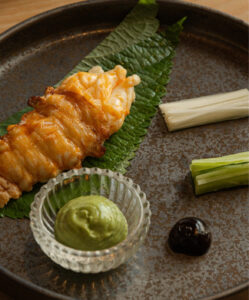
But it’s a flavor they grew up with. So, I thought about how to make it work as a refined dish. We currently serve a Moreton Bay Bug dish where we blend Vegemite with black garlic and vegetable broth into a puree. The Bug is pan-fried with shellfish oil, served Peking duck-style on a green crepe made with spinach puree, with cucumber jelly, leeks, and oyster mayo. It’s a combination of iconic Australian ingredients approached through my lens. It’s very popular, especially with our “Aussie” guests.
Q: What is the greatest joy of this job?
Seeing the guests happy. But also, I just love the space of a restaurant. The people who come to Five are so diverse: couples celebrating birthdays, elderly couples, families, people on a third date. Every table has a different “protagonist.” I love watching that scene from the open kitchen.
Q: Have you had difficult times?
Oh, absolutely. Many. When I was young, I wanted to quit every day. When I first moved to Italy, I was homesick and became distrustful of people. I lived in a share house but was so stressed I didn’t want to leave my room. Honestly… I once even peed in a plastic bottle because I didn’t want to walk to the shared bathroom (Laughs). But it’s a funny story now.
Q: As a chef, what is your non-negotiable value?
Winning over the Europeans. As long as I am playing on their turf, I will never compromise on my respect for their culture. I don’t necessarily believe “the customer is God.” I will not do anything that shames the culture, techniques, or the chefs I learned from. I won’t break the “rules” of the craft, even if requested.
Q: Advice for young chefs?
Stick to Shu-Ha-Ri. The basics are repetitive, boring, and tough. But without them, there is no “breaking” or “transcending.” We live in an age of AI where recipes and info are everywhere, but please don’t skip the repetition of the basics. If the roots and the trunk aren’t thick, you can’t grow beautiful flowers, and you’ll fall over when the wind blows.
That said, I’m excited about the new generation. Some might skip the traditional path and succeed in business. That’s one kind of “correct.” It’s not for the older generation to interfere. The new era should be built by new people.
Q: What values are needed in the future of food?
(Thinking…)
I think the “background”—where, who, and how food is made—will become even more important. It’s not just taste; it’s the story of the dish and the ingredients. No matter how technology evolves, the fundamental act of a person eating something made by another person won’t change. AI can’t replace that. I believe the value of a chef will only increase.
Finally, what is “cooking” to you?
That’s a tough one… but in a word: “A Dream.”
Thanks to cooking, I’ve traveled to so many countries and had so many experiences. I want to give back. I want the job of “Chef” to return to the top 10 dreams for children. I have to work hard for that. So, cooking is a “dream.”
(Interviewer)
Thank you. “A Dream.” I love that. It’s been moving to dig deep into your life as a chef today.
(Chef Manaka)
Reflecting on my life through these questions has allowed me to face my cooking even more deeply. Thank you.
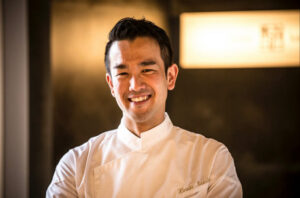
Profile: Hiroshi Manaka
Head Chef, Five (Modern European)
Career Highlights:
Chef Manaka built an international career in Michelin-starred restaurants across Europe. After starting at the prestigious Villa Crespi and Da Vittorio in Italy, he moved to Spain to work at world-renowned establishments like Mugaritz in San Sebastián and Quique Dacosta in Denia. He further expanded his repertoire in Paris at Agapé Substance and La Bigarrade.
In Sydney, he served as Sous Chef at LuMi Dining. Following a period in Tokyo, he returned to Sydney as Head Chef for the launch of Charlotte Bar & Bistro in McMahons Point, while also hosting a pop-up residency at Azabu’s Chef’s Table. Today, he leads Five, offering Modern European cuisine rooted in his extensive European experience and unique Japanese sensibility.