Behind the Kitchen: Real Conversations with Chefs Vol. 4
“Cooking is Love” — The Philosophy of Sushi Chef Akira Horikawa, Continuing to Evolve Across Borders
From Japan to Singapore, and now Australia.
For more than 30 years, chef Akira Horikawa has dedicated his life to the art of Japanese cuisine and sushi.
Having refined his craft across different cultures and countries, his approach to cooking is not about innovation for its own sake. Instead, it remains deeply rooted in simplicity, authenticity, and understanding the people he serves.
In this interview, we spoke with Chef Horikawa about his journey as a chef abroad and the philosophy that continues to guide him.
Profile
Please introduce yourself.
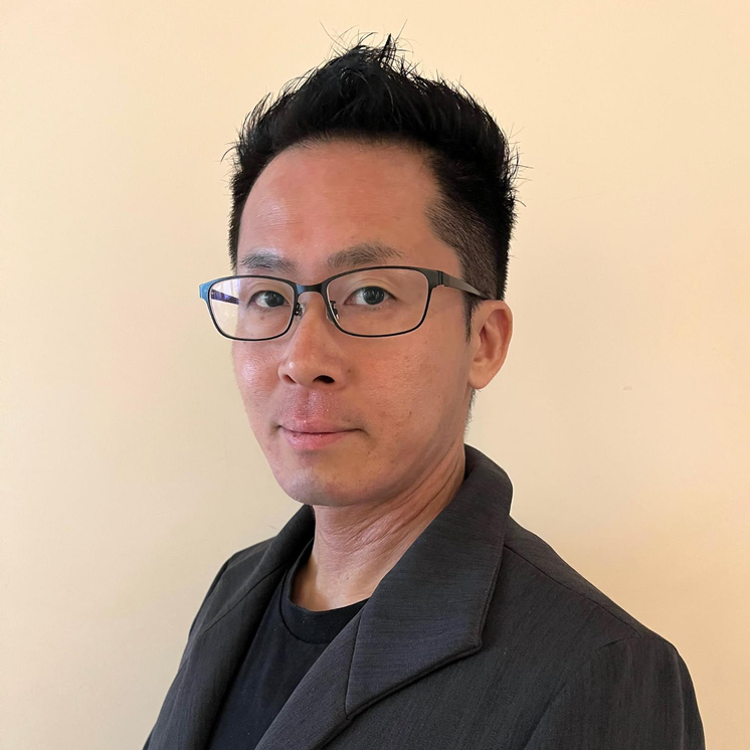
My name is Akira Horikawa.
I have been working in the culinary industry for approximately 30 years, primarily specializing in Japanese cuisine.
I began my career at a traditional kappo restaurant, where I learned the fundamentals of Japanese cooking. After that, most of my career has been devoted to sushi.
Over the years, I have built my career across Japan, Singapore, and Australia.
Origins and Inspiration
What inspired you to become a chef?
Looking back, I realize that many of the people I met throughout my life influenced my decision to enter this profession.
One experience in particular stands out.
When I was young, there was a U.S. military base near my home—Yokota Air Base. I had the opportunity to attend English conversation classes there and participated in a barbecue event.
During the event, someone from the base asked me:
“Why don’t you show us something Japanese?”
At that moment, I realized I couldn’t.
I was around sixteen or seventeen years old, and at the time I was fascinated by America and rarely paid attention to my own culture.
That single question made me reflect deeply on what it meant to be Japanese and became one of the reasons I entered the world of Japanese cuisine and sushi.
I had always enjoyed cooking at home, but that experience helped me decide that this would become my profession.
Turning Points and Going Overseas
Was there a major turning point in your career?
There have been several, but the opportunity that led me overseas came through a friend from Kyubey.
He was working in Mexico and was preparing to open his own restaurant there. He was looking for someone to take over his position, so I asked him, “Would I be considered?”
He welcomed the idea, and I even progressed to the interview stage.
In the end, however, the opportunity fell through.
Still, that experience sparked a strong interest in working overseas, and I began actively looking for opportunities abroad.
That was about six years ago.
A Culinary Philosophy Refined Overseas
Has any particular person, culture, or place influenced your current cooking style?
The customers I met in Singapore had a significant impact on me.
I had always tried to tailor my food and sushi to each guest, but overseas I became even more conscious of maintaining the fundamentals while adapting to what local guests would find most enjoyable.
Singapore also has a large Chinese community, so naturally I adjusted my cooking to suit their preferences.
How did you adapt your cuisine?
In terms of flavor, many guests found traditional Japanese seasoning slightly strong or intense.
As a result, I sometimes reduced the strength of the soy sauce or softened the overall seasoning.
I also began serving more warm dishes.
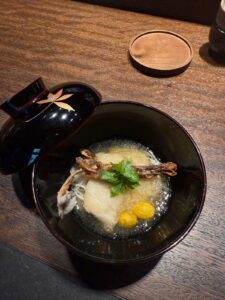
For example, I serve chawanmushi and grilled fish with shellfish-based sauces underneath, creating flavors that feel familiar and comforting to local guests.
Culinary Philosophy
What do you always keep in mind when cooking?
The people who will be eating my food.
There is a famous saying from a chef I greatly respect:
“Water for flowers, love for people, and love in cooking.”
No matter how delicious the food may be, I believe it is difficult to truly move people unless genuine care and consideration for the guest form the foundation of the dish.
What makes your cooking uniquely yours?
If I had to describe it in one word, it would be simplicity.
I strive to express the natural qualities of each ingredient as honestly as possible.
For example, when serving sea bream, I want guests to experience not only its flavor but also the essence of what makes sea bream unique.
What is your most important criterion when selecting ingredients?
Understanding the inherent strength and character of the ingredient.
Even ingredients of the same type have individual characteristics.
I evaluate whether those characteristics align with the direction I want to take and whether I have the ability to bring out the ingredient’s full potential.
Technique and Innovation
What adjustments do you make when working with Australian ingredients?
When it comes to seafood, Australia offers many high-quality products.
However, the way fish is handled can vary, so I adjust my preparation methods according to the condition of the fish.
For example, in Japan it is generally uncommon to wash filleted fish with water, but depending on the condition of the fish, I may choose to do so.
What do you consider when combining traditional techniques with new ideas?
First and foremost, whether I genuinely find it delicious myself—and whether it has gone too far.
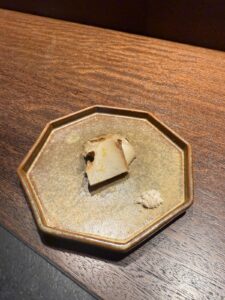
For example, when developing a cheese-infused chawanmushi, I went through numerous trials before finding a balance that felt truly enjoyable.
Have you recently explored any new techniques or ingredients?
Recently, I incorporated a 25-year-aged balsamic vinegar into a somen noodle palate cleanser.
Because there is an Italian restaurant next door, I am fortunate to be exposed to ingredients and ideas that I may never have encountered otherwise.
Food as an Experience
How do you create moments of surprise or excitement through food?
My primary goal is simply to make food that people find delicious, so I do not intentionally chase surprise.
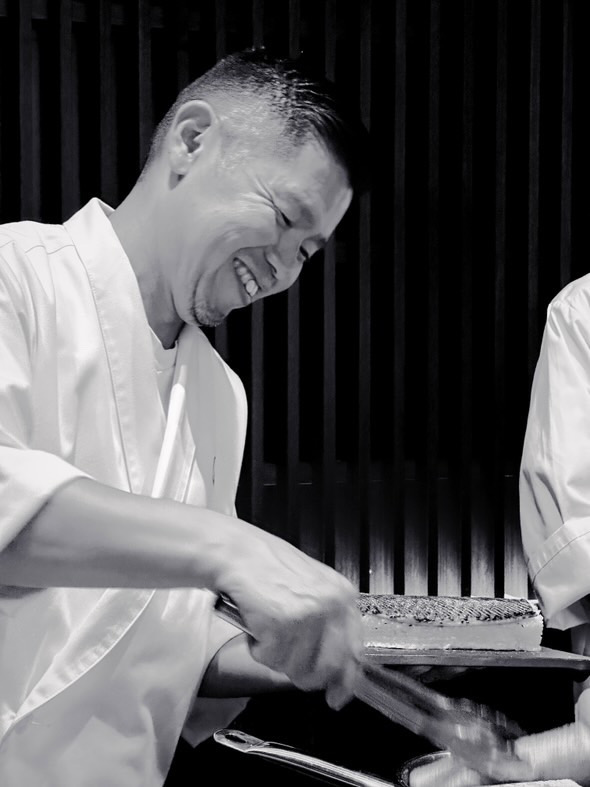
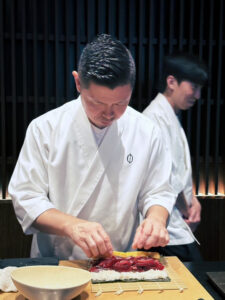
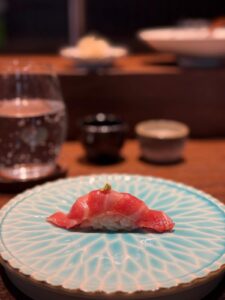
That said, I sometimes create memorable experiences by presenting a whole block of tuna, slicing it in front of guests, and then immediately preparing sushi before their eyes.
In those moments, the experience itself becomes part of the meal.
Joys and Challenges
What is the greatest reward of your work?
The moment a guest says, “That was delicious.”
This profession involves long hours and many challenges, but hearing those words makes everything worthwhile.
Our entire team works together for that moment.
Have you faced any particularly difficult periods?
There have been many.
Recently, I developed tendonitis in my right hand. Then I fell and injured my left hand in an awkward way.
At the same time, the colleague who usually supported me was on an extended leave.
I continued working while struggling with injuries in both hands.
When I finally went to the hospital, I discovered that my left hand had actually been fractured.
Fortunately, surgery was not necessary, and it was already beginning to heal.
What kept me going was my desire to meet the expectations of our guests.
Advice for Future Chefs
What is a value you will never compromise on?
I am not particularly stubborn about many things, but if I had to choose one value, it would be creating food that is simple and easy to understand.
What message would you give to young chefs?
In the past, if a young person—or even my own child—had said they wanted to become a sushi chef, I probably would have told them not to because the profession is demanding.
Today, my perspective has changed.
Through this career, I have had opportunities to work overseas and experience the world.
Although it is challenging, I believe it is a wonderful profession, and I encourage young people to take on the challenge and continue pursuing it.
What values will be important in the future of food?
Respect for producers and fishermen, as well as systems that support them.
We can only do our work because they provide the ingredients.
I believe it is essential to appreciate their efforts and create a society that supports them.
Finally, what does cooking mean to you?
Cooking is love.
Thank you very much for your time.
Listening to Chef Horikawa, it became clear that his craft is not defined solely by technical skill, but by a genuine commitment to understanding and caring for the people he serves.
We look forward to seeing how Japanese cuisine continues to evolve around the world through chefs like him.
Bonus Feature: Life Overseas
Working in Australia
What was your impression of Australia before coming here?
Like many people, I had the typical image of Australia—beautiful beaches, surfing, koalas, and kangaroos.
What made you want to work overseas?
The opportunity in Mexico was what first opened my eyes to working abroad.
Although that opportunity ultimately didn’t happen, it sparked my interest in exploring opportunities outside Japan.
Why did you choose Australia?
I was originally working in Singapore, but when the restaurant closed, I needed to find a new opportunity.
Through an agent’s introduction, I was offered a position in Australia, which is how I ended up here.
What differences have you noticed between working in Japan and Australia?
To be honest, I don’t feel there are huge differences in the actual work itself.
However, Australia’s higher labor costs certainly influence how businesses operate and manage their teams.
What do you enjoy most about working in Australia?
One of the biggest attractions is having the opportunity to work with Australian ingredients that I had never used before.
Another major benefit is the work-life balance.
In Japan, taking extended paid leave can be difficult, even when you’re entitled to it. In Australia, I’m able to return to Japan twice a year for three to four weeks at a time.
For me, that means I can fully focus on work while I’m in Australia and fully focus on my family when I’m back in Japan.
I’m not particularly good at balancing multiple things at once, so being able to separate work and family life in this way has been a great advantage.
Do Japanese chefs have strengths when working in Australia?
Absolutely.
Particularly in Japanese cuisine, there are still barriers to entry because of English-language requirements, such as obtaining IELTS scores for visas and migration pathways.
As a result, there are fewer Japanese chefs entering the market than there could be.
On the other hand, that means opportunities still exist.
For Japanese chefs and sushi professionals, there is still room to leverage their skills and expertise in Australia.
How do Australians view Japanese food?
I feel that Japanese food is viewed in two different ways.
One is as an everyday meal, such as sushi rolls and casual Japanese food.
The other is as a cultural experience.
Restaurants like ours fall into the second category. Guests come not only to eat but to experience something uniquely Japanese through food.
For people who frequently visit Japan, our restaurant can evoke memories of their travels.
For those who have never been to Japan, it can serve as a way to experience Japanese culture for the first time.
Every day, we work hard to meet those expectations.
What is important when working overseas?
Never forget that you are Japanese, while also remaining flexible and adaptable.
Personally, I feel that by choosing to work overseas, I am representing Japan in some small way.
If someone leaves with a more positive impression of Japan because of an interaction with me, that makes me very happy.
How do you spend your days off?
Mostly doing everyday things like laundry and shopping.
If I have extra time, I like to visit other restaurants to learn from them, and I also spend time studying for IELTS.
What is the most memorable trouble you’ve experienced in Australia?
There have been plenty of amusing challenges! (laughs)
The most recent one happened not long ago.
I returned to my accommodation and couldn’t get the door open properly. When I finally managed to enter, I discovered that the glass shower screen had suddenly shattered into countless pieces.
Fortunately, the reception staff quickly arranged another room for me, so everything worked out.
I’ve encountered various unexpected situations while living overseas, but I’ve been fortunate to receive kindness and support from many people along the way.
Advice for Those Considering a Career Overseas
What advice would you give to people who want to work abroad?
If you want to go overseas, take action as early as possible.
If it doesn’t suit you, you can always come back.
The most important thing is taking that first step.
For anyone considering Australia—especially those aiming for employer sponsorship or permanent residency—I strongly recommend obtaining your IELTS qualification in Japan before coming.
It will make the process significantly easier.
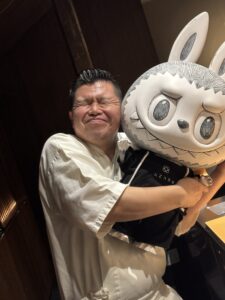
Akira Horikawa
Head Chef, Omakase at Prefecture 48
Sydney, Australia
Career Journey
My first job was actually at a small bar operated by the family of a childhood friend.
Through that job, I met many different people.
One day, a businessman who owned a computer-related company approached me and said, “Why don’t you come work for my company?”
At the time, however, I wasn’t particularly interested in that field, so I told him honestly.
He then asked me, “So what do you want to do?”
Without much thought, I replied:
“I’m thinking about attending culinary school.”
His response was immediate:
“Then go work at my younger brother’s restaurant.”
Before I knew it, he had taken me to a traditional kappo restaurant in Ichikawa, Chiba.
If my memory is correct, the gentleman was a former member of the Japanese national soccer team.
One thing he said has stayed with me ever since:
“Instead of paying money to learn cooking, it’s better to get paid while learning.”
That advice became the foundation of my career.
After gaining experience at several restaurants, I joined Kyubey in Ginza, where I spent approximately fifteen years learning the fundamentals and true essence of sushi craftsmanship.
Later, I moved to Singapore and joined the opening team of a new restaurant with around thirty seats, serving as Head Chef.
For approximately eighteen months, I was responsible for leading the operation.
Although the business itself did not achieve the results we had hoped for, I was able to build strong relationships with guests and develop a loyal base of returning customers.
That experience taught me the importance of tailoring business strategies to a restaurant’s size, concept, and target audience.
Today, I serve as Head Chef of Prefecture 48 OMAKASE in Sydney, Australia.
I have not yet decided where my journey will take me next.
However, I intend to continue following the connections and relationships that have guided me throughout my career and use them as a compass for whatever comes next.